Zevonix Business Suite | All-in-one Operations Manager Platform

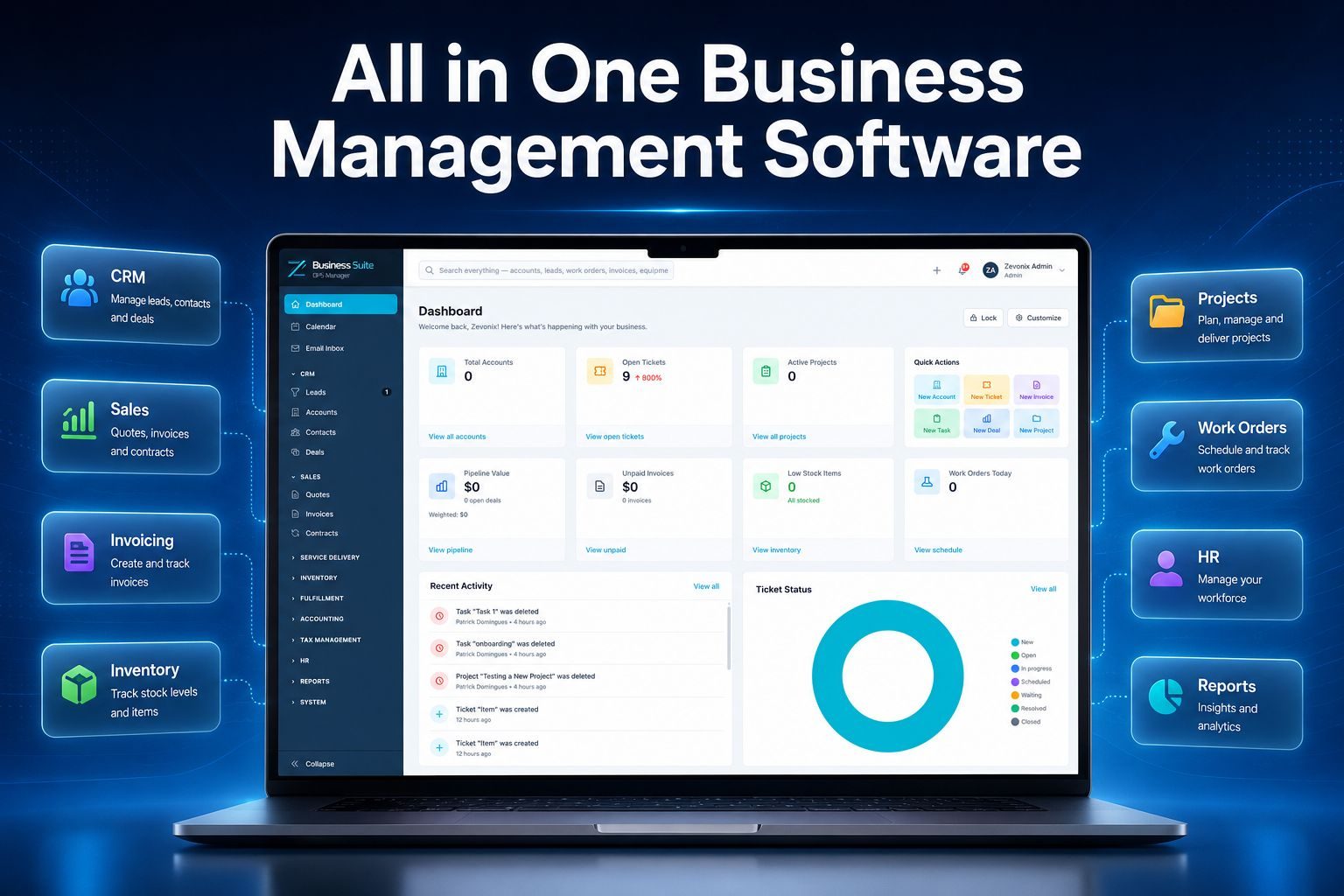
If your team is updating customer records in one system, invoicing from another, tracking jobs on a whiteboard, and fixing accounting errors at month end, the problem is not your staff. It is your software stack. All in one business management software exists to remove that friction by putting core workflows into one connected system.
For small and mid-sized businesses, that change is not cosmetic. It affects billing speed, job profitability, inventory accuracy, tax handling, payroll support, and how quickly managers can trust the numbers in front of them. When operations are spread across disconnected tools, every handoff creates delay, duplicate entry, and risk. A unified platform reduces those points of failure.
What all in one business management software actually means
The phrase gets used loosely, so it helps to be precise. True all in one business management software does more than bundle a few adjacent apps under one login. It connects functions that usually break apart inside growing companies: CRM, estimates, invoicing, double-entry accounting, project tracking, support, purchasing, inventory, workforce administration, reporting, and customer communication.
The key difference is shared data. A customer created by sales should flow into invoicing. A completed service job should update billing. Purchased inventory should affect stock counts and financial records. Employee activity should support payroll and reporting. If each department still has to export, import, or re-enter information, you do not have one system. You have multiple tools wearing matching colors.
That distinction matters most for operational businesses. Contractors, field service firms, distributors, wholesalers, manufacturers, and service companies do not just need contact management and invoices. They need dispatch visibility, inventory control, job costing, document handling, audit history, and financial accuracy that survives real-world complexity.
Why disconnected tools become expensive faster than expected
Most software stacks start small and look affordable. A CRM here, accounting software there, another app for field service, another for tickets, then payroll, inventory, file storage, reporting, and tax support. On paper, each monthly subscription seems manageable.
The real cost shows up in labor and failure points. Staff re-key customer data. Finance teams reconcile mismatched records. Managers wait for reports because data lives in different places. Service teams lack billing context. Sales promises work that operations cannot staff or source. Inventory numbers drift. Month-end close drags out because nobody trusts the inputs.
This is where businesses often misread the problem. They assume they need better discipline, more admin support, or more integrations. Sometimes they do. But often the bigger issue is that the operating model depends on software fragmentation.
An all in one platform changes that model. Instead of managing the gaps between systems, the business runs through one environment with one source of truth. That improves speed, but more importantly, it improves control.
Where all in one business management software delivers the most value
The strongest gains usually appear in cross-functional workflows, not in isolated tasks. A standalone invoicing tool can send invoices. A standalone CRM can manage leads. The advantage of all in one business management software is what happens between those actions.
Sales to service to billing
When a quote becomes a job without manual transfer, teams lose less time and fewer details. Scope, customer information, line items, service history, and payment terms move forward together. That reduces admin load and shortens the time from completed work to invoiced work.
Inventory to purchasing to finance
Businesses that stock parts, materials, or finished goods need operational and financial records to stay aligned. If inventory changes live outside accounting, margin reporting gets distorted fast. A connected system keeps purchasing, stock levels, usage, and financial impact tied together.
Workforce activity to payroll support and compliance
Labor is one of the largest cost centers in service and operations-heavy companies. If time, attendance, scheduling, and job activity sit in separate tools, payroll support becomes slower and more error-prone. A unified system improves accountability and reduces the clean-up work that happens before payroll runs.
Support, service history, and customer communication
Customers do not care which department owns the issue. They expect one company that knows their account, prior work, documents, invoices, and open requests. Unified records make that possible without internal chasing.
What to look for in all in one business management software
Not every broad platform is a fit for small and mid-sized companies. Some products offer wide functionality but come with enterprise complexity, expensive implementation projects, and consultant dependence. Others are easy to buy but shallow where operational businesses need depth.
A better evaluation standard is workflow coverage plus usability. Look for a system that can handle accounting, invoicing, CRM, projects or jobs, support, inventory, reporting, and workforce processes in a way that reflects how your business actually runs.
You should also pay attention to deployment speed and pricing clarity. If software only works after months of customization and a large services bill, many SMBs will never realize the expected return. Predictable monthly pricing and faster implementation matter because they reduce adoption risk.
Security and control matter too. Dedicated cloud environments, role-based access, audit trails, and document management are not just enterprise concerns. They matter to any company that handles payroll data, tax records, contracts, customer files, and financial approvals.
The trade-offs you should expect
There is no perfect software category, and all in one business management software has trade-offs. A specialized tool may go deeper in one narrow area than a unified platform. If your business has highly unusual requirements in only one department, you may still need a targeted add-on or process adjustment.
There is also a change management factor. Consolidating tools forces teams to adopt standardized workflows. That is usually a benefit, but it can expose habits that developed around older systems. Businesses that want the value of unification have to be willing to clean up process inconsistency.
The good news is that most growing SMBs do not need endless customization. They need a system that covers the majority of operational requirements well, keeps data connected, and gives leadership clear visibility without consultant-led complexity.
Who benefits most from an all in one approach
The companies that get the biggest return usually share a few traits. They have multiple departments touching the same customer record. They manage jobs, inventory, billing, or service workflows. They are tired of exporting spreadsheets to answer basic questions. And they feel friction between operations and finance.
That is why this category fits field service companies, contractors, distributors, wholesalers, manufacturers, and operational service businesses especially well. In those environments, software fragmentation does more than waste time. It weakens margins because labor, materials, billing, and cash flow are tightly connected.
A business owner should be able to see what was sold, what was delivered, what was billed, what was paid, what remains outstanding, and how the job performed financially. If that answer takes three systems and two employees to assemble, the business is carrying avoidable overhead.
How to evaluate whether it is time to switch
A good trigger is not simply company size. It is operational strain. If your team spends significant time reconciling data, correcting invoices, chasing documents, or manually moving information between systems, the stack is already slowing growth.
Look at how many tools are involved in one end-to-end process. For example, from lead to quote to job to invoice to payment to financial reporting, count the systems touched and the manual steps in between. That number tells you more than subscription cost alone.
Also measure reporting delay. If managers cannot get same-day visibility into sales, service load, receivables, stock position, or profitability without spreadsheet work, decision-making is being held back by system design.
This is where a platform like Zevonix Business Suite fits the market well. It is built for companies that need ERP-style coverage across sales, service, accounting, inventory, support, HR, payroll support, tax management, documents, and client communication without taking on enterprise software baggage.
The practical case for consolidation
The strongest reason to adopt all in one business management software is simple: fewer systems means fewer breaks in the business process. That leads to less duplicate data entry, fewer reconciliation issues, faster billing, cleaner financials, stronger accountability, and more reliable reporting.
For SMBs, that is not an abstract efficiency story. It affects cash flow, headcount pressure, customer experience, and management control. A company that replaces eight disconnected tools with one connected platform is not just simplifying IT. It is reducing operational drag across the entire business.
The right system should help you run tighter, not just look more modern. If software can connect your sales activity, service execution, accounting records, workforce processes, and customer communication in one environment, your team spends less time managing software and more time managing the business.
That is the standard worth using: choose software that removes friction between departments, gives finance cleaner inputs, and lets operations move without waiting on manual fixes.